Drink Factory Simulator Recipe Discovery & Analysis Mode
No handed formulas — learn how to test ingredients, lock ratios, and earn high scores.
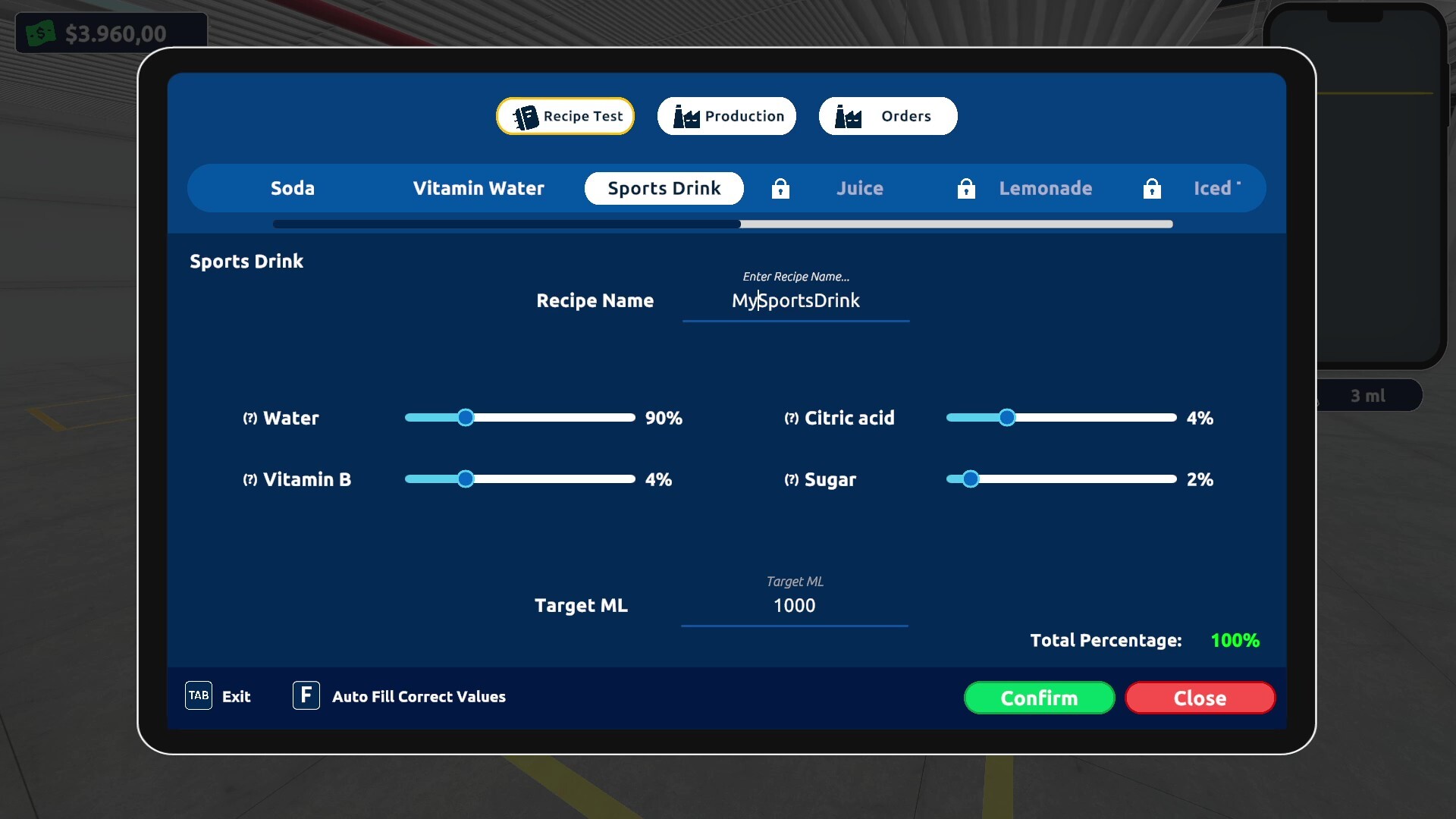
How to find recipes in Drink Factory Simulator
Recipe discovery is not a side quest in Drink Factory Simulator — it is the product. Agosto Game Studio designed the sim so no recipes are handed to you. Every soda, cola, energy drink, or experimental blend starts as a hypothesis: which ingredients belong, and what percentage each should claim. You prove that hypothesis in Analysis Mode, then protect your margins when the same formula hits the production line.
This guide teaches how to get better formulas faster without spoiling finished drinks. Use it beside Getting Started on day one, and return whenever an order board demands a style you have not stabilized yet.
What “discovery” actually means
In many management games, a research tree or vendor unlocks a static recipe card. Here, the card is blank until your tests say otherwise. You choose ingredients, assign ratios that total 100%, run analysis, and read whether pieces of the mix are correct, incorrect, or directionally close. A strong score is permission to manufacture; a weak score is a warning to stop filling bottles.
Because there are no official cheat codes and no wiki-complete formula dumps in the design fantasy, your competitive advantage is process: note-taking, controlled experiments, and knowing when a “good enough” score is safer than chasing perfection while orders expire.
Analysis Mode: your laboratory
Enter with a question
Before you touch sliders, write one sentence: “I am testing a citrus soda with three ingredients” or “I am replacing one wrong component in yesterday’s cola attempt.” Aimless tweaking burns cash and attention.
Build a 100% formula
Every valid test should have ingredient percentages that add up to 100%. Incomplete totals make feedback harder to trust and teach bad habits for production scaling. If you remove an ingredient, redistribute its share deliberately; do not leave a ghost percentage hanging.
Change one variable when you can
Scientific habits win. If analysis says two ingredients are wrong, avoid rewriting the entire drink in one click. Fix the clearest offender, re-test, then attack the next signal. Multi-variable swings occasionally luck into a winner, but they destroy your ability to learn why a score moved.
Read feedback as a map, not a grade only
Scores matter for orders and pride, yet the qualitative signals — which parts are correct vs wrong — are how you climb. Treat a middling score with clear “this ingredient is right” flags as progress. Treat a high score you cannot explain as fragile; document it immediately before you forget the ratio set.
Exit to production on purpose
Analysis Mode is not the factory floor. When feedback looks stable, take a small pilot through mix/blend → sterilize → fill as described in Production Line. Lab scores that die in sterilization or filling teach a second lesson: process quality and recipe quality are partners.
A practical discovery workflow
- Scout the order — Note drink category and quality expectation from the board (Orders and Deliveries).
- Pick a short ingredient shortlist — Prefer fewer components for the first success; complexity can come after cashflow is safe.
- Draft ratios to 100% — Round to values you can remember under stress.
- Run Analysis Mode — Record correct/wrong signals and the score in a notebook or spreadsheet.
- Iterate in small steps — Adjust 5–10% swings rather than coin-flip rewrites when you are close.
- Pilot batch — Produce a limited run before you commit pallets to a timed gate.
- Lock and label — Name the formula in your notes with date and score so co-op partners can reuse it.
- Revisit after upgrades — New machines or ingredients later in Early Access may change cost curves even if ratios stay valid.
Cost control while you experiment
Discovery eats ingredients. New players often bankrupt the fun by treating Analysis Mode like an infinite sandbox. Budget a testing allowance each day: a fixed cash or unit cap for failed mixes. If you hit the cap, fulfill a known good order to refill the treasury, then resume research.
Co-op helps here. With up to three friends online, one player can own analysis while others keep a proven line earning money. That split stops the classic failure mode where everyone stands in the lab arguing about citrus percentages while delivery gates go idle.
Scoring, quality, and “good enough”
Chasing a perfect 100 on every drink feels great and is often wrong for business. Early Access economies punish lateness. A slightly lower score that you can manufacture quickly may beat a perfect blend you cannot stabilize before night ends. Use score thresholds tied to order requirements: meet the bar, ship, then improve the recipe in the next quiet window.
When a drink will become a flagship product you expect to sell for many sessions, invest the extra analysis time. When an order is a one-off bridge payment, be pragmatic.
Categories you will experiment toward
Store materials and prologue messaging call out families such as soda, cola, and energy drinks, with more variety expected as Early Access content grows across the planned 6–12 month window. Do not assume every category uses the same ingredient logic. Keep separate notebook sections so a cola breakthrough does not overwrite your soda baselines.
Future updates have been described as adding more recipe components alongside systems like store sales and open-world truck routes to port/airport hubs. More ingredients mean more discovery depth — and more reason to keep disciplined notes.
Co-op discovery etiquette
- One shared notebook (voice chat summary + text) beats four conflicting memories.
- Call out when a formula is “pilot only” vs “approved for pallets.”
- Never silently change a locked ratio mid-shift without telling logistics.
- Rotate the analyst role during the Prologue so everyone understands feedback language before EA week one.
Mistakes that stall discovery
- Hoping a guide or cheat portal will paste finished ratios — that fights the genre fantasy and is not supported officially.
- Testing with ratios under or over 100%.
- Changing every slider after a single bad result.
- Skipping pilot batches and flooding the line with unknowns.
- Ignoring cost per successful test when ingredients spike.
- Forgetting to re-validate a formula after you change sterilize/fill setups.
How recipe work connects to the rest of the wiki
Discovery feeds everything. Getting Started shows where analysis sits in the day loop. Production Line turns a scored formula into bottles and pallets. Orders and Deliveries pays you for quality-on-time. Controls reduces misclicks while you fine-tune percentages. Review Overview explains why this trial-and-error lab is the reason many players will love or bounce off the game. Browse the full set from the Guides Hub.
Session drill: twenty-minute research block
Set a timer for twenty minutes. Choose one unfinished drink family. Run at most five analysis attempts, changing one major variable each time, always totaling 100%. After the fifth attempt — success or not — leave the lab and ship something sellable. This drill trains decisive learning and protects the factory from infinite research spirals.
Master that rhythm and you will know how to find recipes in Drink Factory Simulator the way the designers intended: by earning them.
Frequently Asked Questions
Quick answers about recipes, factory lines, and Early Access.
Does Drink Factory Simulator give you recipes?
No. Recipes are not handed out. You discover drinks by experimenting with ingredients and ratios in Analysis Mode.
Why must ratios total 100%?
Analysis Mode evaluates a complete formula. Percentages should add to 100% so feedback and scoring stay meaningful.
Is there a cheat code to unlock all drinks?
There are no official cheat codes. Progress comes from testing, scoring, and production — not console unlocks.
When should I stop analyzing and start producing?
When your score meets the order’s quality needs and a small pilot batch survives mix, sterilize, and fill without nasty surprises.
Can friends help with recipe discovery?
Yes. Online co-op for up to three friends lets one player focus on Analysis Mode while others earn cash on the line and deliveries.